Eastern Europe · The Balkans · The Alps
Borders,Stories &Second Looks
Eleven days from Moldova to the Swiss Alps, and one day we didn't know we had.
Monasteries and a city of wine underground. A country almost nobody recognizes. Wartime Odesa, San Marino's three towers, Kosovo with a guide who lived through the war, and a Swiss evening forty years in the making.
- 11days
- 4new countries
- 2new TCC regions
- 9places on the ledger
Moldova to the Alps · 9 places, 13 legs
What the
Pockets Kept
Boarding passes, a paper slip instead of a stamp, a taxi fare, a ferry we missed by three minutes. The trip, as the ephemera tells it.
Миграционная карта
Pridnestrovian Moldavian Republic
- Entry · Bender
- 27 · 06 · 2025
- No passport stamp issued
Taxi · Chișinău
Day 1
ODESA · 29.06 · 12 ▶
Pristina · aircraft to Kosovo
15 min
Lake Lucerne ferry
Eleven days, in order
- 01
Frankfurt → Chișinău
First Night in Chișinău
Jun 25 Wed - 02
Curchi → Orheiul Vechi → Cricova
Faith Above Ground, Wine Below It
Jun 26 Thu - 03
Chișinău → Bender → Tiraspol
The Country That Almost Exists
Jun 27 Fri - 04
Hîncești → Beșalma → Comrat
Gagauzia
Jun 28 Sat - 05
Chișinău → Odesa → Bologna
The Day We Weren't Supposed to Have
Jun 29 Sun - 06
San Marino
The Republic on a Rock
Jun 30 Mon - 07
San Marino → Bologna → Vienna → Pristina
Three Towers and a Stopwatch
Jul 1 Tue - 08
Pristina → Prizren → Pristina
Pins, Flags and a Fortress
Jul 2 Wed - 09
Pristina → Skopje → Pristina
Bekim
Jul 3 Thu - 10
Gadime → Rugova → Peja → Zurich
The Long Way to the Airport
Jul 4 Fri - 11
Zurich → Lucerne → Bürgenstock
Forty Years Later
Jul 5 Sat
Prologue
8:10 in the Evening
The plan was tidy.
Moldova, San Marino and Kosovo: three new countries. Transnistria and Gagauzia: two new regions on the Travelers’ Century Club list, the one that counts places the way most people count countries. Italy on the way through, because we never mind Italy. Switzerland at the end, for a reason I’ll come to.
Ten days, give or take. I had it on a spreadsheet. It came out at eleven.
Then we looked at the booking again. Our flight out of Chișinău left at 8:10 in the evening. Not in the morning.
That gave us a whole day we didn’t know we had. A local guide was willing to drive us to Odesa and back.
Ukraine was at war. It had never been on the list. Over breakfast we asked each other whether we could actually do this.
We went. That’s Day 5.
The reason for Switzerland is simpler. Neeta and I had each been there before we were married, almost forty years ago. We had never been back together. Of all the countries in Europe, it was the only one like that.
First Night in Chișinău
We landed in Frankfurt at 6:00 AM, about an hour late. Bags off the Condor flight, a long passport line, then back through for the 10:10 Lufthansa to Chișinău. The Senator Lounge across from the gate got us through the wait.
We reached Chișinău closer to 2:00 PM. A driver was holding a board with our name on it. Moldovan immigration asked us nothing at all. I pulled about $150 in lei from the ATM, at roughly 17.5 to the dollar, and we checked into the Courtyard and slept.
By 6:00 we were up again. In late June the sun sets close to 9:00, so the evening is really a second afternoon. A taxi dropped us near Cathedral Park.
We walked. The Nativity Cathedral and its bell tower. Stephen the Great on his pedestal. Parliament, the opera house, Organ Hall, the post office, City Hall. Nothing hurried, just getting a feel for the distances.
We finished at Plincuvin, a self-service wine shop.
Taxi in: 97 lei. Taxi back: 65.
Faith Above Ground, Wine Below It
Curchi Monastery was badly treated in the Soviet years and has been restored with real care. Baroque fronts, clipped lawns, pale churches in open country. There were six of us in the van that morning, with Ecaterina guiding (Catherine, she said, if that was easier). The outside is for photographs. Inside, among the frescoes and gilded iconostases, we stayed longer than we had planned.
At Orheiul Vechi the old cave monastery is cut into a limestone ridge above the valley. Higher up are a newer monastery and a bell tower with the whole countryside below them. While we were inside, a priest began to sing the prayers. We didn’t understand a word of it.
Lunch in Butuceni ran on village time. Neeta and I are vegetarian, which in rural Moldova means polenta, red borscht and potatoes. We had no complaints.
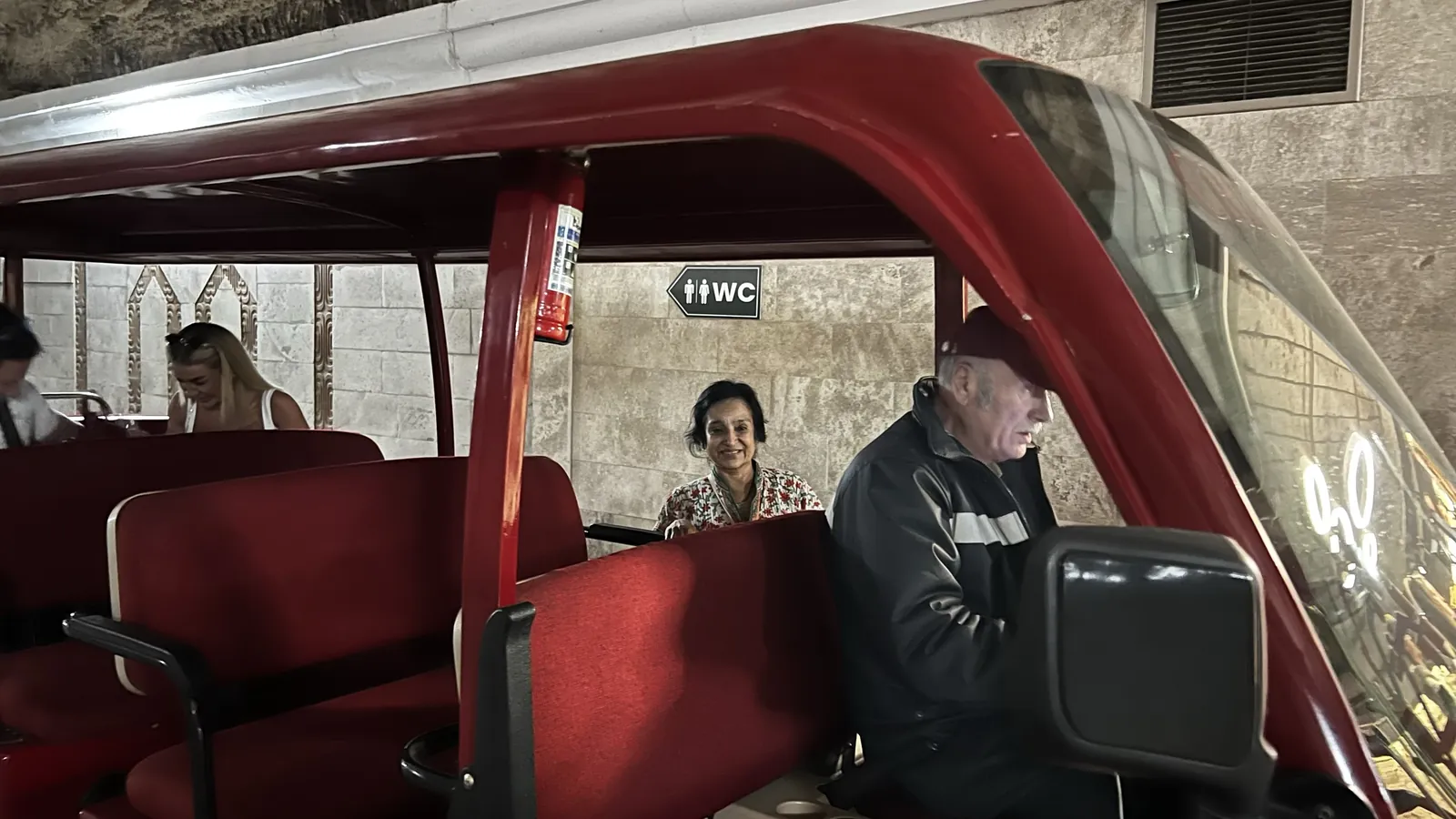
At Cricova we went down roughly 100 meters into limestone tunnels whose streets are named after wines. A small train took us about three kilometers in. The full network runs many times that.
There are cellars and production halls, a tasting room that seats about sixty, and a small cinema that tells the history. Mostly there are streets lined with bottles.
Our guide told us about Cricova’s standing in Soviet times. I bought a wall clock made from a flattened wine bottle.
On the drive back into Chișinău we passed the arena and the big Soviet-era circus building. We were at the hotel by 6:00.
The Country That Almost Exists
Oleg from Moldova Tours took one look at my camera bag and told me to leave it behind.
A big camera, he said, makes you look like a journalist in Transnistria. Not a tourist.
The camera stayed at the hotel.
On the drive east Oleg walked us through Moldova’s history with Romania, with the Soviet Union, and with the strip of land we were heading into. Then the checkpoints. He asked us not to photograph the Russian peacekeepers or the border post. We handed over passports. Transnistria calls itself the Pridnestrovian Moldavian Republic, and no UN member recognizes it, so there was no stamp. Instead we got a paper migration slip.
For anyone who keeps a TCC list, that slip is the whole point. Transnistria has its own border guards, currency and parliament, and almost nobody else recognizes it as a country.
Bender sits on the west bank of the Dniester, but Transnistria controls it. We saw the tank memorial and buildings still marked by shellfire from 1992. Oleg’s version of that war took most of the drive: the Soviet collapse, language laws, local power, a Soviet army still on the ground. A few months of fighting, and then a freeze that has lasted more than thirty years.
Across the river, Tiraspol looks like the Soviet Union forgot to leave. Parliament with Lenin out front. One square holding memorials to World War II, Afghanistan, 1992 and Chernobyl. Catherine the Great in a park. The House of Soviets, with portraits of model workers on the wall.
Lunch was at a place called Back in the USSR. Ladas, old refrigerators, radios, typewriters. Service was slow.
On the way back we stopped at Bender Fortress, an Ottoman stronghold from the sixteenth century. Sweden’s King Charles XII spent years in exile here after losing to Peter the Great. A single minaret is left from the garrison mosque.
Gagauzia
Manuc Bey, in Hîncești, is an estate with Armenian, Ottoman, Moldovan and Romanian history all tangled together. Slava picked us up at 9:10 and had us there by 10:00.
The mansion is built like a French château. The furniture is period style, not original, and nobody pretends otherwise. Underneath are traces of a hamam, old stonework and a short tunnel we walked through to the next building. There is a water tower and a Gothic hunting lodge.
South of there the country flattens out. Brown corn, green wheat, sunflowers, in blocks that run to the horizon. I kept the long lens on the field lines from the car window.
The Gagauz speak a Turkic language, and most of them are Orthodox Christians. I had not known that before this trip.
In Beșalma, the ethnographic museum founded by the writer Dmitri Kara Çoban was meant to be a quick stop. It took almost an hour. Our hosts went through clothing, weddings, courtship, migration and faith, and they talked about all of it as something the community had fought to keep.
At Christmas, we heard, boys went around singing, and a girl could pin a flower on the hat of the boy she liked. Outside, the village church was light blue with gold onion domes.
Lunch was at Gagauz Sofrasi in Congaz, where every group gets its own small room or little house. The menu leans hard on meat. We did fine.
We finished in Comrat, the regional capital, at St. John the Baptist Cathedral.
The Day We Weren't Supposed to Have
We left the hotel at 5:20 AM and reached the Ukrainian border at 7:20.
Moldovan officers took our passports first, then Ukrainian ones. Between the two posts stood painted pylons, one set in each country’s colors, and a strip of ground that belonged to neither. Twenty or thirty minutes later we were in Ukraine.
We knew the US advises against all travel to Ukraine. This was one day, on one road, with a local guide, and we had weighed it carefully.
Neeta wasn’t well. Eight years earlier, on the far side of the Black Sea in Batumi, the same kind of trouble had turned serious, and she was not taking chances. No food, no coffee, for a while not even water.
Odesa was beautiful and visibly at war. The older buildings looked tired. War posters were everywhere. We parked near City Garden before the cafés were properly awake. The first one turned us away. The second gave in at about 9:00. A coffee shop on Havanna Street was beautiful inside, and it became our base.
City Garden has fountains, sculptures, and a bench for the singer Leonid Utyosov. Deribasivska Street took us to the Passage, a shopping arcade of carved galleries and statues that borrows from Milan and Paris at once.
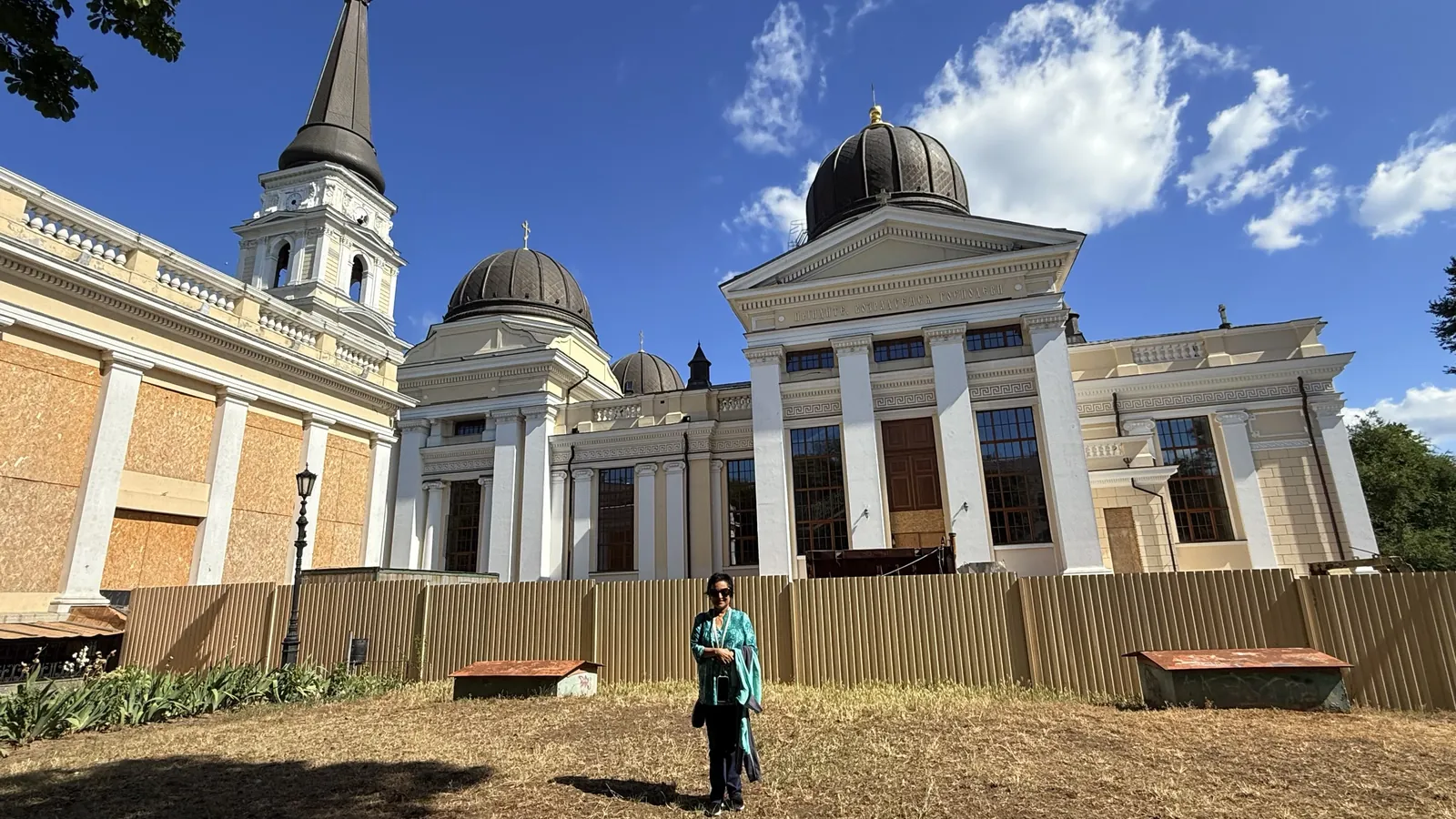
The Transfiguration Cathedral has been destroyed twice. Stalin had it demolished. Ukraine rebuilt it after independence. A Russian missile hit it in July 2023. When we went in, a service was going on under the scaffolding.
Then a small tourist train, with a local guide, Laura, and a driver, Yuri. We named it the Rolls-Royce of tourist trains. The opera house. Greek Square. Jewish Odesa. The house tied to the eye surgeon Vladimir Filatov. And the Potemkin Stairs, built wider at the bottom than the top, so they look different depending on where you stand. The port at the bottom is the reason Odesa exists.
The border back was the real deadline. We still had an evening flight out of Chișinău.
Our own guide, Laurentia, worked the checkpoints like a small bulldozer. What could have taken well over an hour took about fifty minutes. A personal record, she told us.
We were at Chișinău airport by 4:30 PM for the 8:10 PM flight to Bologna. By our standards, that is absurdly early.
The Republic on a Rock
Tradition says a Christian stonemason called Marinus, from the Dalmatian coast, founded a community on Monte Titano in 301 CE. It has been independent, more or less, ever since.
Rafaella met us at 10:00 and spent two hours walking us up and around the mountain.
The old town climbs and folds around the mountain. Cobbled lanes, stone fronts, small piazzas, benches tucked into corners. And shops selling perfume, watches, stamps and coins, set into medieval walls.
At the Basilica, Rafaella explained the Captains Regent. There are two. They serve six months, and they are sworn in on April 1 and October 1.
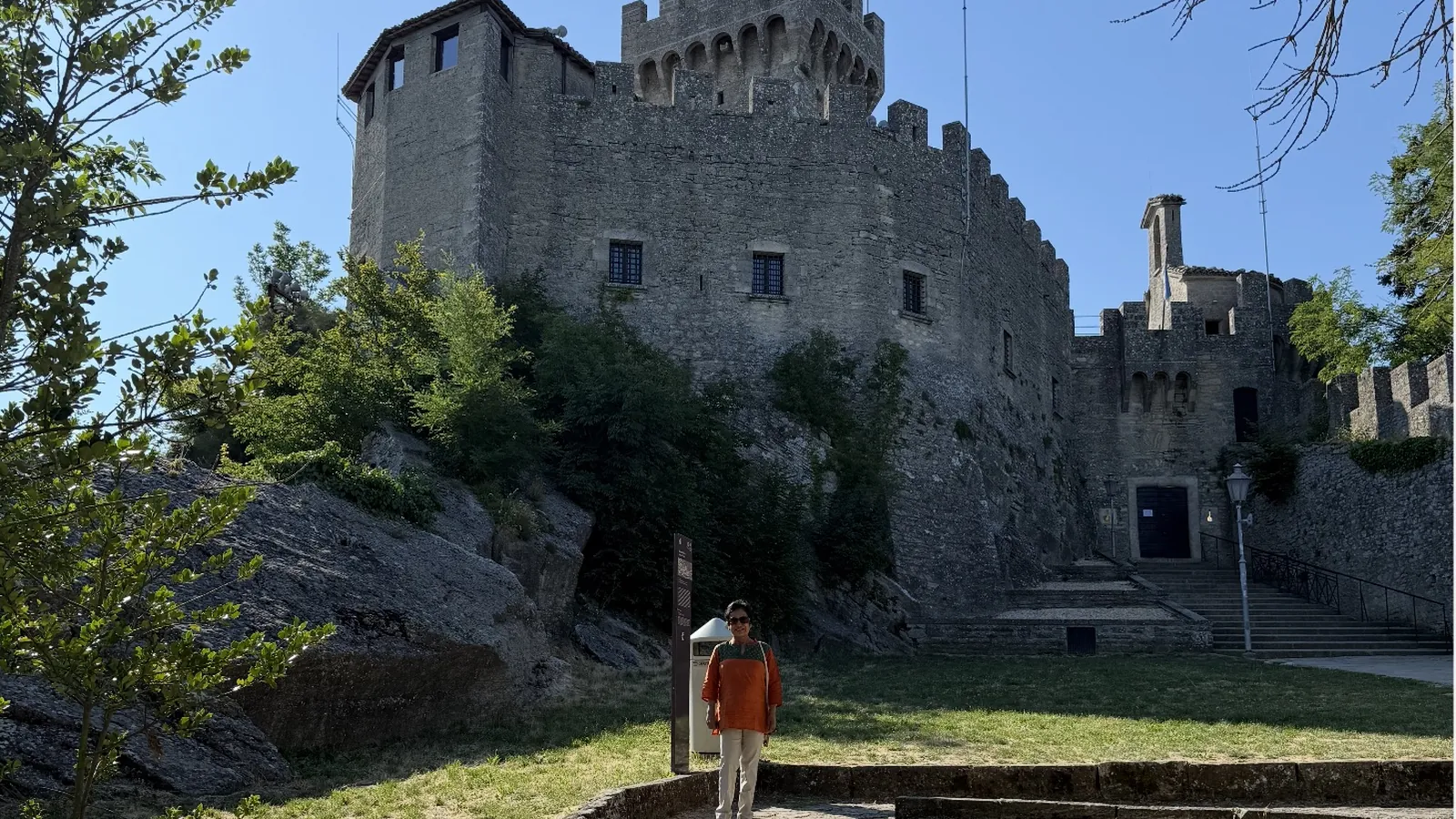
From there we climbed to Guaita, the First Tower, built straight onto the rock with a sheer drop below it.
We said goodbye to Rafaella at noon and had gelato.
The tourist office on Piazza Garibaldi stamps your passport for €5. We paid, twice. We watched the Changing of the Guard at the Palazzo Pubblico, next to the Statua della Libertà, then went looking for stamps and souvenirs.
We also walked into Rolex, where they introduced us to Tudor, the brand Rolex makes on the side. We tried the alternatives, argued a bit, and decided to keep waiting for the exact Rolex we wanted. Omega was the fallback if patience ran out.
Lunch at La Loggia came with wine. After that we went back to the hotel for a nap. Dinner at La Terrazza had few vegetarian choices, so we leaned on red wine and tiramisu.
We left before sunset and walked out past Piazza della Libertà to the cable-car viewpoint. The sky went gold, then dark, over the plain below. I took far too many photographs. We walked back through the stone streets with me still taking them.
Three Towers and a Stopwatch
At 8:00, before breakfast, we went after the other two towers.
Out through the first gate and up steep steps along the wall toward the Hotel Cesare. A fountain on the way, welcome, because it was already warm. Then Cesta, the Second Tower, and the path on to Montale, the Third. With Guaita the day before, that made all three.
Back at the hotel by 9:40. By 10:40 we were at Exel Watches, talking to the owner, Pietro. He had a pre-owned Rolex very close to what we wanted. We had never thought about pre-owned. So we did what we always do with an expensive new idea. We left.
Ten minutes away, at the San Marino Outlet Experience, Neeta found a Furla bag, and we picked up baby sunglasses for our granddaughter, Aanya. Then back to Pietro for more questions. We left again, still without a watch.
Bologna, around 3:00 PM. Galleria Cavour, where the Louis Vuitton was, sits inside the ZTL, the restricted traffic zone, and we had no permit. Waze warnings, parking outside the line and an Uber-and-taxi relay got us in without a fine, and the Louis Vuitton errand got done.
Then the airport sprint, with Hertz return signs that pointed two ways at once, a customs stamp for the VAT refund, and pizza at the gate.
Two hours in Vienna. Then Pristina.
We landed two minutes early. Six minutes later we were at passport control. Two minutes after that, stamped. Seven minutes after that, bags in hand.
Fifteen minutes, aircraft to Kosovo. I timed it.
Pins, Flags and a Fortress
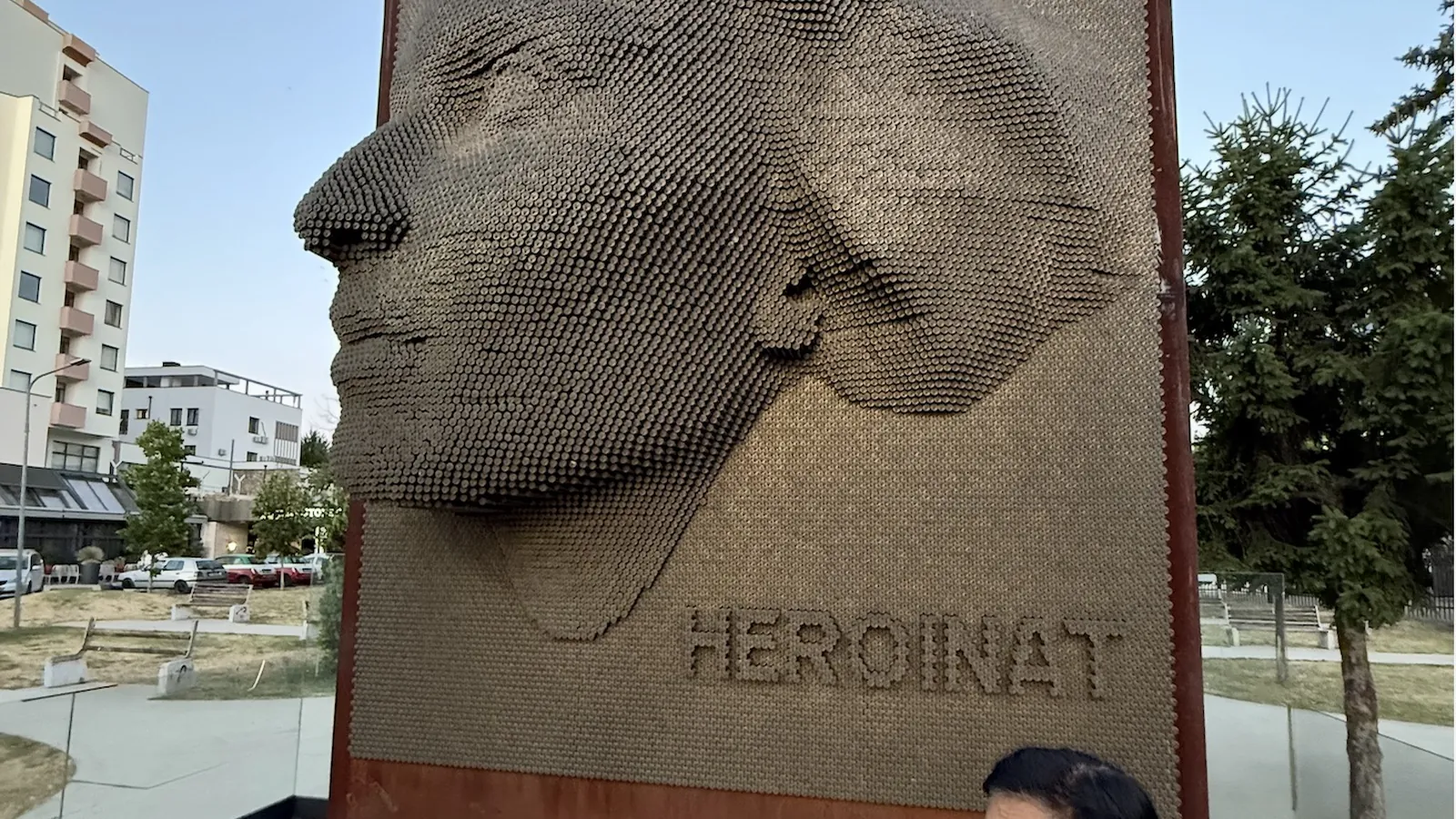
Heroinat is made of thousands of small metal pins. Step back and they become a woman’s face. It honors the women raped during the Kosovo War.
It stands a short walk from NEWBORN, the giant letters unveiled when Kosovo declared independence in 2008. Valon Shkodra, our guide, started us there at 10:15. In Pristina almost every monument points back to the war, or to independence.
Along the pedestrian boulevard: parliament, government buildings, statues of Ibrahim Rugova and Skanderbeg, the memorial to the missing, Mother Teresa. Kosovo and US flags lined the street for the Fourth of July.
The old quarter is smaller in scale. Mosques, a clock tower, a bazaar selling vegetables and household goods, and none of the chaos. Wedding-dress shops and jewelers sit side by side.
Around noon we drove out past the university and its medical complex, through green country, to Prizren.
It was 87°F. In the Sinan Pasha Mosque, Valon showed us the mihrab facing Mecca, the minbar with its narrow staircase where the imam preaches, and the women’s gallery above.
Then we climbed to Kalaja, the fortress. The path is paved with rounded stones, which are hard going in direct sun. Twenty minutes later the whole city was below us. The fortress is medieval, then Ottoman, and slowly being stabilized. Someone had written UÇK on it, for the Kosovo Liberation Army.
Back in town, the four-spout fountain comes with a promise. Drink, and you will come back to Prizren.
We saw a small Byzantine-style church and a Mother Teresa exhibition, which turned out to be a preview of the next day. Lunch near the mosque was flija, börek, cheeses, a spiced cream, bread and ayran. After that, a silversmith, a basilica that was closed, and a hamam under restoration.
Back in Pristina we drove down Bill Clinton Boulevard, past his statue and a clothing shop named Hillary. The Mother Teresa Cathedral was open for quiet prayer, and its stained glass shows her standing with a pope.
Valon dropped us at 7:00. That evening we walked back to NEWBORN and Heroinat on our own.
Bekim
We left with Bekim at 9:45 and reached the North Macedonian border at 10:45. By 11:30 we were in Skopje, driving past an enormous US Embassy to park near the Hotel Bushi.
Skopje’s fortress, the Kale, sits above the Vardar with the whole city below. Bekim spent most of our time up there on something more recent.
Much of central Skopje was rebuilt under a project called Skopje 2014. Giant statues, neoclassical fronts, and a push to link the modern country to antiquity. Critics call it kitsch and political myth-making. The huge “Warrior on a Horse” is Alexander the Great in everything but name. His father, Philip II, stands across the river.
At the Mustafa Pasha Mosque there are no figures, only calligraphy, geometry and flowers. Bekim pointed out the medallions with sacred names, then explained how an Ottoman town works. You need a bath, a mosque, a bakery, a bazaar and a butcher, he said.
Through the Old Bazaar, over the Stone Bridge, to Macedonia Square, where a plaque marks the spot where Mother Teresa’s family home stood. Her Memorial House is a short walk away.
It reopened after lunch and we went in at 1:15. She was born here in 1910 as Gonxhe Bojaxhiu, into an Albanian family. The photographs are small and personal, a young girl long before the saint.
For years communist Albania kept her out, even while she worked all over the world. When she was finally allowed in, in 1989, her mother and sister had both died.
We passed Porta Macedonia, the triumphal arch from the same building spree, and went back to the bazaar for lunch. Tavče gravče, beans baked in a clay dish, and a pomegranate-and-orange juice.
That was when Bekim told us his own story. He told it calmly.
He was fifteen when the war came. His parents had already lost their jobs as things got worse under Milošević. One day armed men came into the house and demanded money and gold. If you want to live, they said, leave.
The family went to relatives. Men came there with demands too. In the end they got on a train to Macedonia. The journey took hours.
They survived. After the war, they came home.
We crossed back into Kosovo at about 3:45 and took the new highway through the mountains near Kaçanik. In Pristina, on the side of the big sports complex, is the face of Adem Jashari, a founding figure of the Kosovo Liberation Army. Serbian forces killed him and much of his family in 1998.
Dinner came with a bottle of Stone Castle, from Kosovo’s own vineyards at Rahovec.
The Long Way to the Airport
The Fourth of July. We spent it in western Kosovo, with Bekim driving again.
We left at 9:30 instead of 9:00. Some of that was on us, and some was luggage logistics at the new Marriott, where the staff were excellent and still learning the building.
On the way out of Pristina we passed Prishtina Mall, which is enormous. Then Gadime, and the Marble Cave.
A local man found it by accident in the 1960s, while he was building something. The hole turned into a marble cavern full of stalactites and stalagmites. It opened to visitors in the 1970s. Entry was €2 each.
West of there the mountains close in. Kosovo borders Serbia, North Macedonia, Albania and Montenegro, and out here the mountains make the borders. Rugova Canyon squeezes the road, the river and the cliffs into one narrow corridor. Tunnels through the rock, overhangs above the road, the river showing up far below. We stood on a glass-bottomed viewpoint and drove past the Marimangat zip line, which we admired with no intention of riding.
The Patriarchate of Peć is a Serbian Orthodox monastery, home to a community of nuns, with several medieval churches joined together. Inside, every wall is covered in saints and Bible scenes. The deep blue in those frescoes was once worth a fortune.
We reached Peja at about 1:05. Bekim went to Friday prayers. We sat by the river with cappuccino and fresh orange juice. Then a walk through the park, the pedestrian boulevard and the old bazaar, now mostly gold, silver and wedding fashion. Kosovo has a name for designer wedding dresses, we were told, and some of the fabric comes from India.
At 2:15 we went to the White Drin waterfall. A shaded path, small bridges, cold rushing water. The restaurant there looked tempting, but we had a plane to catch.
We left at 3:00 and were at Pristina airport by 4:30. Before we said goodbye, Bekim showed us his book. Check-in wasn’t open yet, so we had coffee. The flight slipped to 8:00.
Zurich at 10:00 PM. Another Hertz car. Kameha Grand Zurich. The last country of the trip should have meant an easy night. Instead a bad allergy attack kept me up for most of it.
Forty Years Later
After breakfast we drove to Bahnhofstrasse for one more try at the watch.
Parking was the first Swiss challenge. Bucherer was the second. As usual, the new Rolex stock didn’t suit us. But San Marino had changed something. This time we asked to see pre-owned.
Almost the first one worked. Two walkouts in San Marino, and the watch hunt ended in Zurich.
Omega cost more than it does in the US. The Prada glasses we’d seen in San Marino for €174 were about CHF 450 here.
We tried to drive past Zurich’s old churches. One-way streets and a confused Google Maps turned it into a fight, and we lost. We headed to Lucerne, where we had a Bürgenstock sunset package booked.
The ferry terminal by the station took some finding. We got there at 3:10. The boat had left at 3:07.
Three minutes. We had an hour to kill, and Lucerne had a party going.
The UEFA Women’s Euro was in town, and the fan zone was a sea of orange. Flags, singing, beer, and the kind of optimism I remember from the Patriots years, when winning felt routine. We posed at the Grand Tour of Switzerland display and took the free fruit cups like we had always been fans.
At 4:07 we got on the next boat. Twenty-five minutes across the lake to Kehrsiten-Bürgenstock, then straight up the mountain on the funicular, which has been hauling hotel guests up from the water since the nineteenth century.
The Hammetschwand Lift stops around 6:00, so we went straight to the Felsenweg, a path cut along the cliff with rock on one side and Lake Lucerne dropping away on the other. It leads to the lift, which opened in 1905 and climbs about 153 meters up the open rock face. We got there in time and rode it to the top. It is fast, and completely exposed. The lake, green meadows, and mountains that in places looked like the Dolomites. Back at the resort we tried to get a look at the pool and didn’t manage it.
Our package included drinks. Red wine for me, rosé for Neeta, veggie burgers and fries, and the lake going dark below us. We had each seen Switzerland on our own, forty years ago. This time we were here together.
At 9:00 we rode the funicular down and made the ferry back to Lucerne. The drive to Zurich was uneventful. We got in around 11:00.
Epilogue
Afterwards
Four new countries: Moldova, Ukraine, San Marino and Kosovo. Two new TCC regions, Transnistria and Gagauzia. North Macedonia as a day trip, Italy again, and Switzerland together at last.
I keep those numbers carefully, and I like them. But what I think about now is Oleg looking at my camera bag, Laurentia at the Ukrainian checkpoint, and Bekim telling us about the train.
None of that was on the spreadsheet. Ukraine got onto this trip because we read a flight time wrong.
If you are planning something similar, check your flight times twice. Or don’t.
For the next traveler
Before You Go
Moldova. Give Chișinău an evening on foot before you judge it. Curchi, Orheiul Vechi and Cricova fit into one day. For Gagauzia, hire a guide who can explain the culture, not just drive between sights.
Transnistria. Take the photography rules and checkpoint instructions seriously, and leave the big camera behind. Carry your passport and keep the migration slip you get on entry. Rules change, so check current requirements before you go.
Odesa. We went during a war, and this is not a recommendation. Check official advisories and local conditions close to departure. Border times are unpredictable, so allow far more time than you think you need.
San Marino. Stay overnight if you can. The old town is best early, before the day-trippers, and again at sunset. A guide is worth it, because the politics are much stranger than the postcards. Walk all three towers if your knees agree.
Bologna. Don’t improvise around the ZTL in a rental car. Park outside it, or use a garage that registers your plate.
Kosovo. Pristina makes more sense once someone explains its recent history. Pair it with Prizren. Western Kosovo (Peja, Rugova and the Patriarchate) deserves a day of its own.
Bürgenstock. Get there early enough to do the ferry, the funicular, the Felsenweg and the Hammetschwand Lift before the lift closes. It works as a half-day trip without an overnight stay. Stay for sunset.
Countries & TCC regions
The Ledger
| Place | This trip | Type | Note |
|---|---|---|---|
| Moldova | New | Country | Curchi, Orheiul Vechi, Cricova |
| Transnistria | New | TCC region | Paper migration slip, no stamp |
| Gagauzia | New | TCC region (autonomous) | Beșalma museum, Comrat |
| Ukraine | New | Country | Odesa day trip from Chișinău |
| San Marino | New | Country | Overnight; all three towers |
| Italy | Return | Country | Bologna |
| Kosovo | New | Country | Pristina, Prizren, Peja, Rugova |
| North Macedonia | Day trip | Country | Skopje day trip |
| Switzerland | Return, together | Country | Zurich, Lucerne, Bürgenstock |
Leave one day open
Every journey leaves a signal. Tell Aether where you want to go and how you like to travel, and it will plan the rest.
Plan with Aether